
After ten years working with CRMs, here's what I keep seeing.
"Right, I'm just going to redo the whole thing and delete the lot."
I cannot count how many times I've said that to myself over the past decade. About my own CRM. The one I use every day for my own business. The one I help other people set up for theirs.
If you've ever sat in front of yours and felt the same urge, you're in good company.
I've been working with CRMs since around 2015, when they really started becoming common and cloud-based and affordable enough for small businesses to take seriously. In all that time, I've learnt two things that matter more than almost anything else in this work.
First, this stuff is hard for everyone. Even the people who do it for a living.
Second, the businesses that get the most out of their CRM are not the ones with the cleverest setup. They're the ones who stuck with it long enough to start seeing patterns.
I want to share what I usually see when a new client lands on a discovery call with me. Because nine times out of ten, it's the same three things.
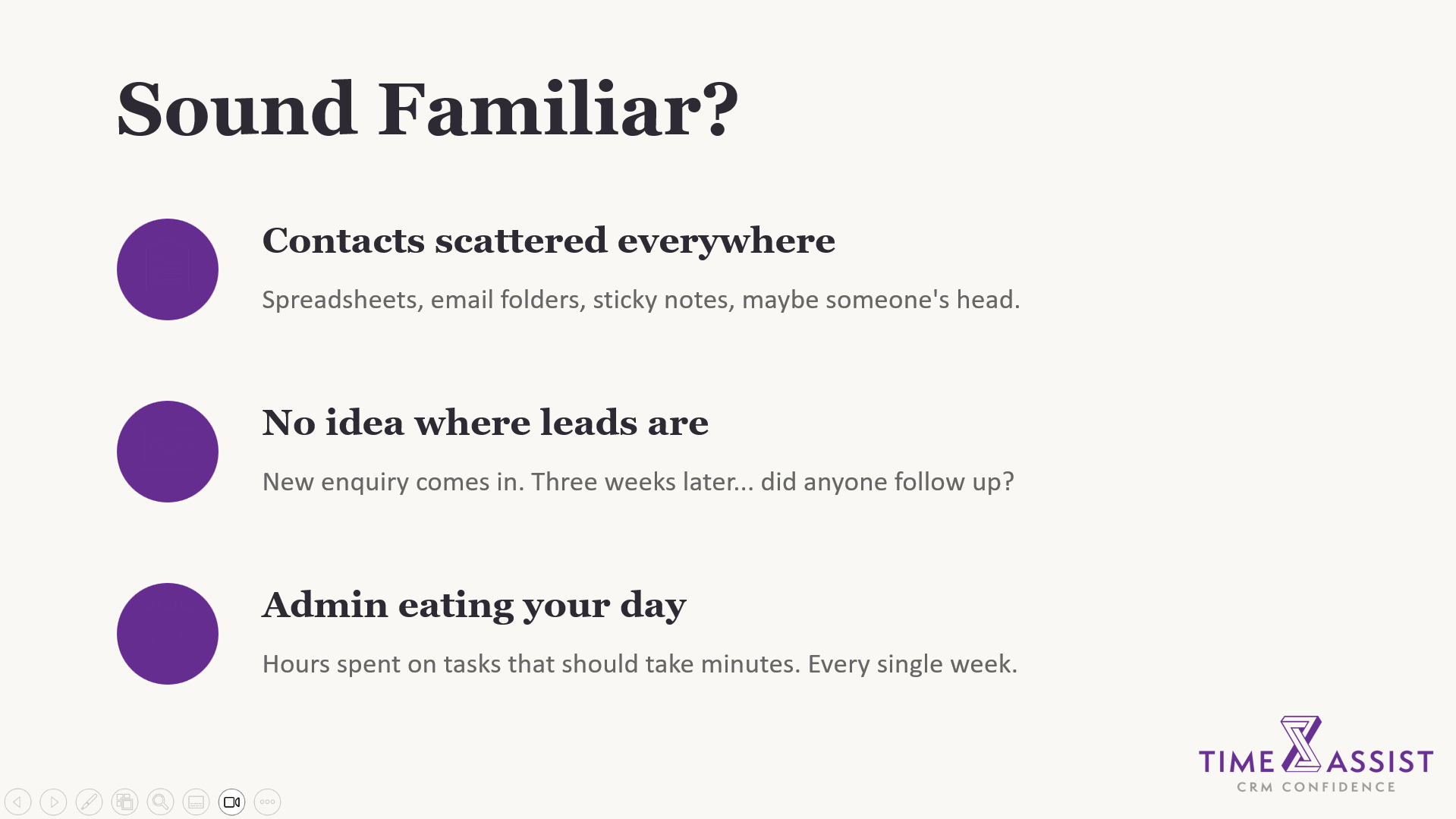
Contacts scattered everywhere
The first one is contacts. Specifically, the fact that nobody knows where they all are.
Have a think about where you've spoken to people about your business in the last week. Email. WhatsApp. LinkedIn. Facebook. Discord if you're in that world. Phone. Networking events. The follow-up coffee where you scribbled their number on the back of your notebook.
This is not a fault on your part. It's just where conversations actually happen now. We have so many channels that no single inbox sees the whole picture. And so the picture lives in your head, until one day it doesn't.
I see this hurting businesses in very specific ways. The recruiter who cannot remember which of three candidates she discussed which role with. The HR consultant who realises, two months in, that three different people on the team have been emailing the same prospect without knowing about each other. The architect who cannot find the spec a builder sent over because it came through WhatsApp and got buried under his daughter's birthday photos.
A CRM gives you one place where the conversation actually lives. So when you pick the phone up, you know exactly where you are. When somebody else picks it up on your behalf, so do they.
No idea where the leads are
The second one is harder to fix because it doesn't feel like a problem until you're already in trouble.
An enquiry comes in by email. It sits at the top of your inbox for half an hour. Then twenty-five other emails arrive on top of it, half of which are absolutely useless. By the end of the day, the enquiry is halfway down the page. By Friday it's gone.
There's a new trend on LinkedIn at the moment where, if you don't reply to a cold message, the sender bumps it back to the top with "just moving this up your list." First time I saw it I was a bit annoyed. Then I realised, I genuinely had not seen the original message. It was at the bottom of a stack of fifty. So although I didn't love being chivvied, the sender had a point.
Flagged emails, pinned WhatsApps, starred LinkedIn messages. All of these are useful right up until the moment you've got fifty of them. Then the flag stops meaning anything.
From what I see with my clients, around a quarter of deals quietly disappear because somebody assumed somebody else was on it. And nobody was. That's not a sales problem. That's a system problem.
Admin eating into your everyday
The third one is the slow leak. About five hours a week, on average, lost to looking for things.
Searching old emails for an attachment. Asking a colleague where she saved the spec. Trying to remember what you quoted to whom and when. It doesn't feel like much on a Tuesday afternoon. Twenty minutes here, ten minutes there. But over a year, that's hundreds of hours of your time, or your team's time, spent finding things that should have been in one place from the start.
What a CRM actually is
Here's something I want to say clearly, because I think it gets misunderstood a lot.
CRM stands for Customer Relationship Management. Honestly, that name sells it short. The way I think about it now, especially for small service businesses, is that a CRM is more like a Contact Relationship Management tool. Your contacts are not just customers. They're prospects, referral partners, network contacts, advocates, suppliers. Anyone in your business ecosystem.
That reframe matters because it changes what you put in there, and how seriously you take it.
It also clears up something I get asked all the time. Your email marketing list is not your CRM. MailChimp is not a CRM. A list of email addresses with no context attached, no notes, no history, no sales pipeline. That is not a CRM. It's a list. There is a real difference.
A proper CRM gives you a visual pipeline, so you can see at a glance where every live opportunity sits. It gives you a place to track client work alongside the sales side. It can automate the repetitive bits if you want it to. And it builds up, conversation by conversation, into something that genuinely tells you about your business.
It really doesn't take as long as you think
The other thing I hear constantly is some version of "I just don't have time for it."
I get it. We're all stretched. But adding a new enquiry into a properly set-up CRM takes less than a minute. Name. Phone number. Email. Save. Then a quick note about what they're after and an expected close date. That's it. You don't have to fill in every field on day one. The point is to capture enough to give the next conversation some context.
The real time saver shows up the third or fourth time you go back to that contact. Because the conversation is already there. The notes are there. The history is there. You don't have to rebuild the picture from scratch every time.
One small piece of advice that I find people get wrong, by the way. Keep your sales pipeline for live opportunities only. Don't kid yourself that you've got loads in the pipeline when half of them are people you spoke to in 2023. If something is genuinely lost, mark it lost and set yourself a task to follow up in six months. That keeps your pipeline honest and your decisions clean.
What sticking with it actually gives you
Which brings me back to the start. The reason I've never actually deleted my CRM, despite the urge, is that the longer I've stuck with it, the more it's told me.
A few weeks ago I went through historic trends in my own data. I've got somewhere between three and four years of clean, consistent enquiry numbers in Capsule. What I found was that every single year, my November enquiries fall off a cliff. So do my March ones. Same networking, same activity, same business. It just happens.
I would never have known that without the data. And I would never have had the data without sticking with the system, even on the days I wanted to bin it and start again.
Now I plan for it. October gets a bit more push. September gets a bit more attention. November still happens, but it doesn't surprise me any more.
That's what a CRM gives you when you stay with it long enough. Not a tidy database. A clearer view of your own business.
A small offer
If you've read all this and recognised yourself in any of it, that's usually the moment to take a proper look at what you're doing.
I run a CRM Audit for £149. It's an hour together, a written report, and an action plan you can actually use. Whether you've already got a CRM and feel like it's not working, or you're trying to work out where to start, I'll give you a clear picture of what's working, what isn't, and what would make the biggest difference if you fixed it first.
Or drop me a message if you'd rather have a chat first.